
Simply viewing most graphic or violent content (gore) for personal interest is generally not illegal in Canada.
However, under Section 163 of the Criminal Code, it becomes a crime if the content is deemed obscene, meaning it unduly exploits sex combined with violence, horror, or cruelty.
Additionally, possessing or accessing any violent content involving minors is a strictly prosecuted criminal offence.
Guiding the legalities of online content in Canada can be confusing, especially regarding graphic or violent material.
While simply viewing most gore content is not a criminal offence, the line is crossed when material meets the legal definition of “obscenity,” specifically when violence is intermingled with sexual activity or involves the exploitation of minors. Learn what is illegal to watch on the internet in Canada.
Understanding the “Community Standard of Tolerance” and the risks of “Criminal Possession” is vital for anyone analyzing the darker corners of the internet.
What Canadian Law Actually Prohibits: Understanding Obscenity
The Canadian legal system doesn’t use the word “gore” in its rulebooks. Instead, it talks about obscenity laws in Canada.
The courts use something called the Community Standard of Tolerance. This test doesn’t ask what you personally find offensive.
It asks what the average Canadian would be outraged to know is being tolerated in their society.
What Gore Content Is Legal to View?
Most people are surprised to learn how much “dark” content is actually protected under the Charter of Rights and Freedoms.
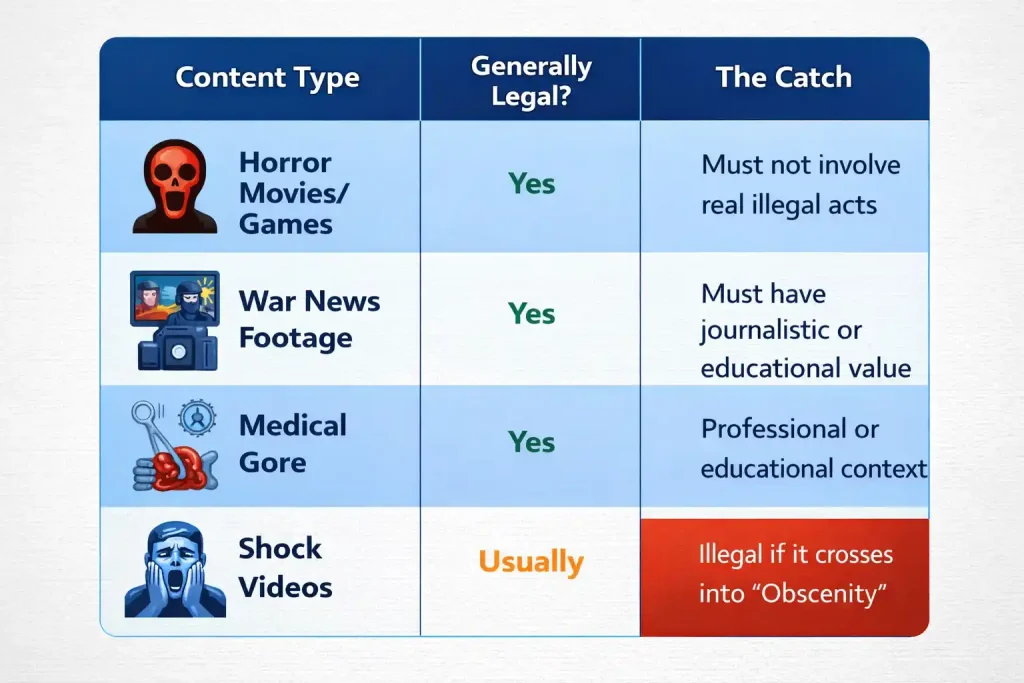
Fictional Violent Content
Movies, video games, and literature that depict extreme violence are almost always legal. Because they are works of fiction and “art,“ they rarely meet the threshold of obscenity laws in Canada unless they are used to incite real-world hatred or violence.
News and Documentary Content
Seeing the harsh reality of war or a natural disaster is legal. If the content has a “public good” or “educational” purpose, such as a medical student watching a surgery or a journalist reviewing war footage, the law provides significant protection.
What Gore Content is Illegal?
The line between “gross” and “illegal” is drawn when the content causes “harm” to society. Watching violent videos in Canada becomes a reality when the material involves:
- Undue Exploitation of Sex and Violence: If a video mixes sexual acts with extreme cruelty or “horror,” it is automatically deemed obscene.
- Hate Propaganda: Content that promotes or incites violence against identifiable groups (based on religion, race, or orientation).
- Child Exploitation: Any violent or sexual content involving anyone under 18 is a straight indictable offence with no grey area.
When Does Viewing Become Criminal Possession?
In the digital age, “viewing” and “possessing” are often the same.
When you watch a video online, your browser often stores a cache or temporary file on your hard drive.
If the material is illegal (like child exploitation or extreme obscenity), having that file on your computer, even if you didn’t save it, can constitute criminal possession.
How the Law Investigates: Law Enforcement Methods
You might think you are anonymous behind a screen, but a criminal lawyer who commits internet crimes will tell you otherwise.
Law enforcement agencies like the RCMP use sophisticated tools to track illegal videos in Canada.
- IP Tracking: Police can track the digital “fingerprint” left when you access specific servers.
- Underground Monitoring: Authorities often monitor “onion” sites and forums where extreme violent content is frequently shared.
- Data Forfeiture: If police have reasonable grounds, they can seize your devices and use digital forensics to find deleted files.
Criminal Charges Related to Gore and Violent Content
If you cross the line into “obscene” territory, you aren’t just looking at a fine. You are looking at a criminal record.
- Possession of Obscene Material: Under Section 163, you could face up to two years in prison.
- Distribution: Sharing a link to an “illegal” gore video is treated much more harshly than just watching it.
- Hate Crimes: If the gore is used to promote hatred, you could face charges under Section 319 of the Criminal Code.
How Criminal Lawyers Defend Internet Content Charges
Being charged with an internet-related crime is terrifying because the evidence feels so “permanent.”
However, a skilled criminal lawyer in internet crimes has several ways to fight back.
- Lack of Knowledge: Just because a file is on your computer doesn’t mean you knew it was there. Malicious ads or “pop-unders” can download data without your consent.
- The Artistic Defence: If the content can be shown to have literary, artistic, or scientific merit, it may not be legally “obscene.”
- Charter Violations: If the police searched your computer or phone without a proper warrant, that evidence might be thrown out of court.
Common Penalties for Obscenity and Internet Crimes
| Offence | Type | Potential Penalty |
| Possession (Obscenity) | Hybrid | Up to 2 years |
| Distribution | Indictable | Up to 2 years |
| Child Exploitation | Indictable | Mandatory minimums apply (1 year+) |
Protect Your Digital Future
The internet is vast, but it is not lawless.
While curiosity is a human trait, it can lead you into legal traps that are difficult to escape. If you ever find yourself being questioned by police regarding your search history or the content you’ve viewed, the most important thing you can do is stay silent.
Always remember:
- Don’t talk to the police without an advisor.
- Don’t try to “delete” evidence, as this can lead to obstruction of justice charges.
- Seek a professional who understands the technical side of the law.
Contact Linh Pham at Regina Criminal Law today for a confidential consultation.
Frequently Asked Questions
1. What is considered to be gore?
In a legal and digital context, gore refers to graphic visual representations of real-life physical trauma, such as dismemberment, extreme bleeding, or death. While not a specific legal term, the law classifies this material as “obscene” if it is depicted in a way that exceeds community standards of tolerance or is combined with sexual themes.
2. Is sending gore to a minor illegal?
Yes. Sending graphic or violent material to a minor can lead to charges of “corrupting morals” or “making obscene material available to a child.” If the content has any sexual undertones or is sent to facilitate a meeting, it can trigger severe “child exploitation” or “luring” charges under the Criminal Code.
3. Can I be charged for watching a video I didn’t download?
Yes, technically. In Canada, “accessing” illegal content (specifically child sexual abuse material) is a crime even if you don’t save the file. For general obscenity, the law usually requires an element of possession or distribution.
4. What should I do if I accidentally click on an illegal link?
Close the window immediately. Do not save or share the link. If you are concerned about your digital safety, consult a criminal lawyer specializing in internet crimes before contacting anyone else.
5. Are shock sites like “BestGore” illegal to browse?
Browsing the site itself is generally not a crime, but many videos hosted on these sites cross into the legal definition of “obscene” or “illegal videos Canada” because they combine sex with extreme violence.